
Why a clean AAV preparation matters and how routine quality control and advanced characterization contribute to a clearer picture.
Adeno-associated virus (AAV) has become a central platform for in vivo gene delivery due to its favorable safety profile, broad and engineerable tropism, and capacity for long-term expression in non-dividing cells (Naso et al. 2017; Haggerty et al. 2019; Wang et al. 2024). In gene delivery, the vector is not just a delivery vehicle. It is the reagent that sets the ceiling on the entire experiment. This makes AAV characterization essential for confirming vector quality, consistency, and experimental reliability.
While teams may focus on titer as the key quality measure, titer alone does not describe other variables present in the preparation. Two preparations with comparable genome titers may differ in protein impurities, particle aggregation, or capsid content. These differences can complicate dose interpretation, introduce experimental variability, and make unexpected biological results more difficult to troubleshoot. Assessing AAV purity before starting an experiment can help identify vector-related issues early, potentially avoiding weeks or months of troubleshooting unrelated experimental parameters.
What does AAV purity mean?
AAV purity testing evaluates the composition of the vector preparation and the extent to which unwanted material is present. It is not usually represented by a single measurement.
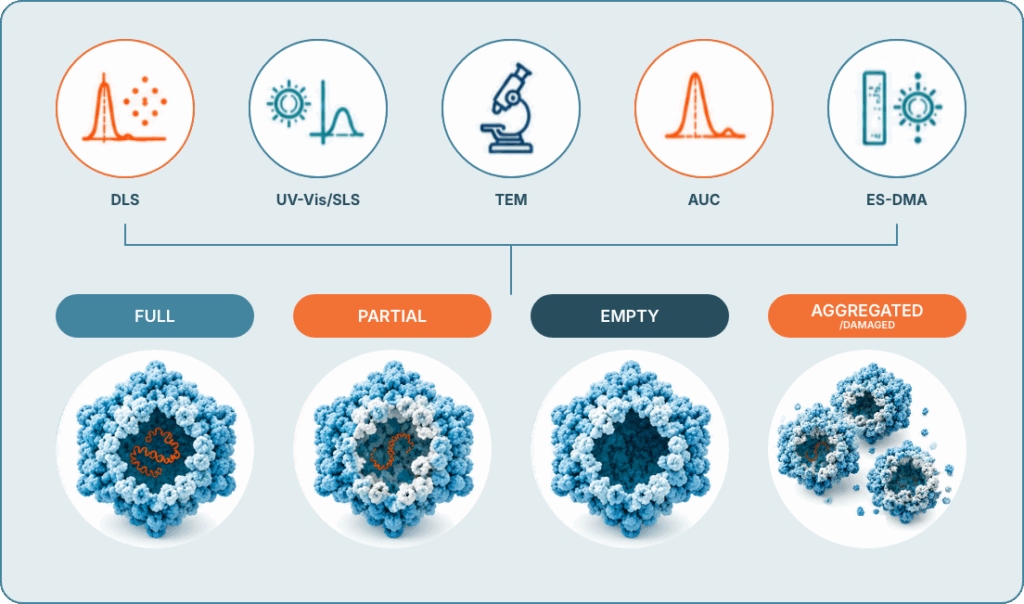
AAV preparations may contain more than the intended intact, genome-containing particles. Impurities include residual host-cell proteins, host-cell or plasmid DNA, process-related contaminants, and non-AAV particulates. In addition to protein and nucleic-acid impurities, AAV preparations may also contain empty, partially filled, and full capsids, as well as aggregated or structurally abnormal particles (Figure 1).
For practical purposes, AAV purity can be considered in three aspects of a preparation: 1) capsid protein composition, 2) particle physical condition, and 3) capsid population distribution. Each can be relevant to reproducibility, especially when the vector will be used for demanding in vivo experiments. Routine AAV QC provides an initial assessment of these characteristics, while advanced characterization can provide more detailed information about capsid populations when needed. Purity-related measurements also overlap with other quality attributes, including capsid content, so it is important not to treat any single factor as a complete description of vector quality.
Purity is one of six critical quality attributes. The Vector Biolabs AAV QC eBook AAV Characterization: A Practical Guide to Standard and Advanced Quality Control covers all six and the methods behind each. Download the guide.
What routine AAV quality control can tell you
A standard QC package should be viewed as a set of complementary measurements, not as isolated tests. To assess AAV purity, Vector Biolabs uses SDS-PAGE with silver staining to assess capsid protein purity and Stunner analysis to examine particle characteristics.
Checking capsid proteins
Sodium dodecyl sulfate polyacrylamide gel electrophoresis (SDS-PAGE) separates denatured proteins by molecular weight. Silver staining provides high sensitivity to visualize capsid proteins and off-target protein impurities.
AAV preparations are expected to exhibit three characteristic viral capsid proteins: VP1 (~87kDa), VP2 (~73kDa), and VP3 (~62kDa). The presence of additional bands, smearing, or unexpected protein patterns may indicate residual host-cell proteins, process-related impurities or protein degradation. Importantly, a preparation that appears acceptable by optical measurement alone may still contain protein impurities since absorbance cannot distinguish them from capsid protein.
At Vector Biolabs, SDS-PAGE with silver staining is routinely performed on every AAV preparation to assess capsid protein purity and evaluate the presence of unexpected protein bands. This analysis provides valuable information about the protein composition of the preparation and complements other quality control methods. However, SDS-PAGE does not assess residual DNA, endotoxin, or other non-protein contaminants, highlighting the importance of a comprehensive QC strategy for evaluating overall AAV quality.
Checking particle characteristics
The Stunner platform combines UV-Vis spectroscopy, dynamic light scattering (DLS), and static light scattering (SLS) in a rapid, particle-analysis workflow that needs as little as 2 µL of sample (Liu et al. 2024).
DLS can flag aggregation or broad particle-size distributions, UV-Vis can support genome/capsid content estimates, and SLS adds particle mass and concentration-related information. Together, these readouts help identify preparations that may appear acceptable by titer alone but contain aggregation, unexpected particle size distributions, or capsid content estimates that fall outside expectation (Gimpel et al. 2021; Liu et al. 2024).
These are screening-level measurements rather than a definitive description of every particle population. The capsid content estimates assume a payload size of 4,000 bp, and buffer composition, serotype, and the presence of aggregates all influence the readouts. Together, these measurements provide an overview of particle characteristics and complement the protein-purity information obtained from SDS-PAGE.
When might advanced characterization help?
Routine QC may be sufficient for many research applications, while advanced characterization can provide additional information when greater confidence in vector quality is needed. This may include high-impact in vivo studies, characterization of new capsids, changes in manufacturing processes, or lot-to-lot comparability. Advanced characterization can also help investigate unexpected QC results or biological performance issues that routine measurements cannot fully resolve, such as unexplained particle heterogeneity (Gimpel et al. 2021; Kontogiannis et al. 2024).
Advanced characterization methods such as analytical ultracentrifugation (AUC), electrospray differential mobility analysis (ES-DMA, available on the NanoRanger platform), and transmission electron microscopy (TEM) provide complementary information about capsid content, particle heterogeneity, aggregation, and morphology.
Measuring capsid content: empty, partial and full capsids
AUC can characterize empty, partial, and full capsid populations, while ES-DMA provides high-resolution profiling of capsid content, including overfilled capsids and higher-order particle species.
Visualizing particle morphology and aggregation
TEM provides direct visualization of AAV particles, helping identify aggregates, damaged or structurally abnormal capsids, and non-AAV particulate material. TEM therefore contributes to both identity and purity assessment.
AAV Purity: Building confidence before the experiment
For AAV purity, the practical starting point is simple: look beyond genome titer, confirm that the expected capsid proteins are present, and check for unexpected particle-size or aggregation signals. Where standard QC leaves uncertainty, targeted advanced characterization can provide a more complete picture of the material being studied.
The objective of measuring AAV purity is to recognize when an unexpected signal, inconsistent biological performance, or a more consequential experiment calls for additional information. A well-characterized preparation helps researchers distinguish possible vector-related problems from biological or experimental variables.
What purity testing cannot tell you
When an experiment underperforms and the purity data looks acceptable, the next question is which attribute to check. Identity, product strength, potency, safety, and stability each answer something purity cannot. The Vector Biolabs AAV QC eBook works through all six, with the methods that assess each and what their readouts mean. Download AAV Characterization: A Practical Guide to Standard and Advanced Quality Control.
References
Gimpel AL, Katsikis G, Sha S, Maloney AJ, Hong MS, Nguyen TNT, Wolfrum J, Springs SL, Sinskey AJ, Manalis SR, Barone PW, Braatz RD. Analytical methods for process and product characterization of recombinant adeno-associated virus-based gene therapies. Mol Ther Methods Clin Dev. 2021 Feb 17;20:740-754.
Haggerty DL, Grecco GG, Reeves KC, Atwood B. Adeno-associated viral vectors in neuroscience research. Mol Ther Methods Clin Dev. 2019 Nov 26;17:69-82.
Kontogiannis T, Braybrook J, McElroy C, Foy C, Whale AS, Quaglia M, Smales CM. Characterization of AAV vectors: a review of analytical techniques and critical quality attributes. Mol Ther Methods Clin Dev. 2024 Jul 30;32(3):101309.
Liu X, Jean-Gilles R, Baginski J, Cai C, Yan R, Zhang L, Lance K, van der Loo JCM, Davidson BL. Evaluation of a rapid multi-attribute combinatorial high-throughput UV-Vis/DLS/SLS analytical platform for rAAV quantification and characterization. Mol Ther Methods Clin Dev. 2024 Jul 15;32(3):101298.
Naso MF, Tomkowicz B, Perry WL 3rd, Strohl WR. Adeno-associated virus (AAV) as a vector for gene therapy. BioDrugs. 2017 Aug;31(4):317-334.
Wang JH, Gessler DJ, Zhan W, Gallagher TL, Gao G. Adeno-associated virus as a delivery vector for gene therapy of human diseases. Signal Transduct Target Ther. 2024 Apr 3;9(1):78.