
Custom AAV Production
Custom vectors ship in as little as 4-5 weeks, and are produced to >95% purity with endotoxin levels <0.3 EU/ml. Every production also includes our standard analytics package at no additional cost, giving you confidence in the quality and identity of your vector.
Do it yourself
& Quotes
Custom AAV Production in Four Steps:
STEP 1.

STEP 2.
STEP 3.
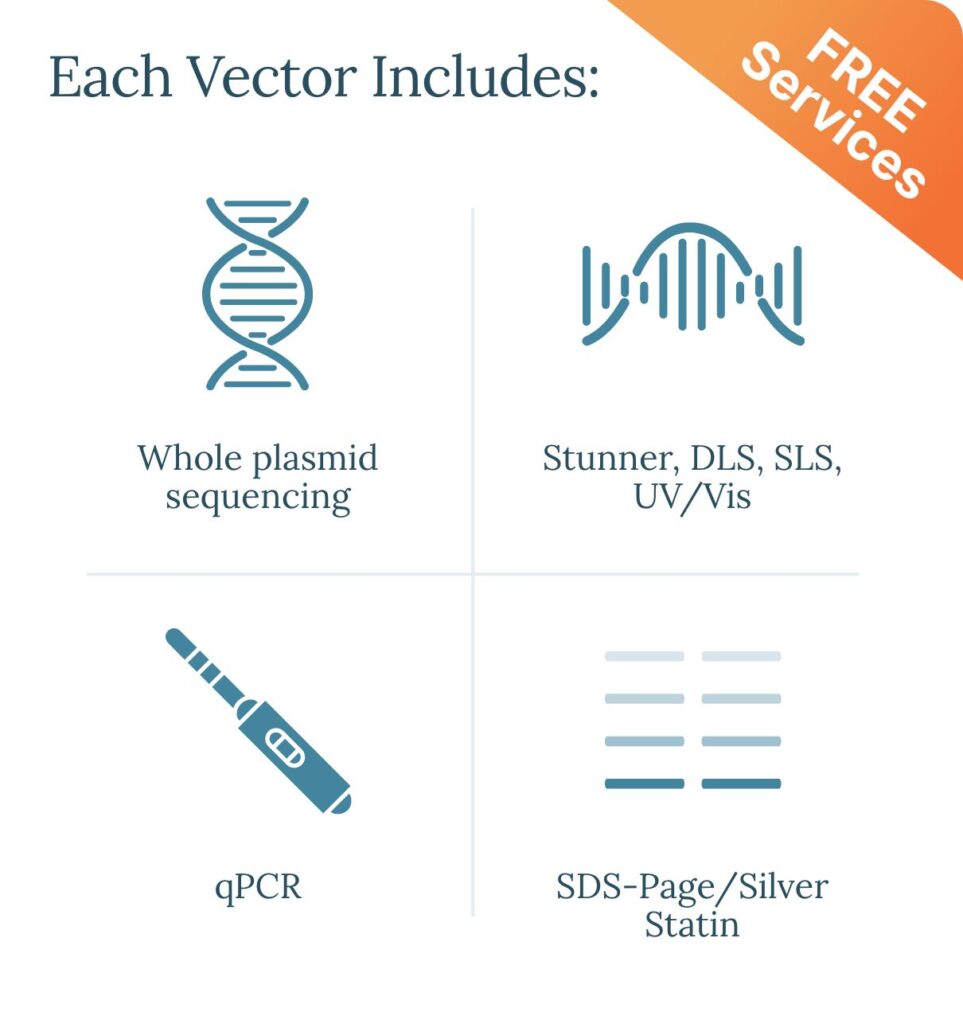
- Whole plasmid sequencing
- qPCR Titer
- DLS/SLS/UV-Vis (Stunner)
- SDS-Page/silver stain
- dPCR
- AUC
- LAL Endotoxin
- TEM
- ES-DMA
STEP 4.
document.getElementById('aav-cp-download-btn').addEventListener('click', function () {
  const files = [
    '/wp-content/uploads/2025/07/AAV-vs-Traditional-Transgenic-Mouse-Model.pdf',
    '/wp-content/uploads/2025/07/Brochure-VB-QR-s.pdf'
  ];

  files.forEach(fileUrl => {
    const a = document.createElement('a');
    a.href = fileUrl;
    a.download = '';
    a.style.display = 'none';
    document.body.appendChild(a);
    a.click();
    document.body.removeChild(a);
  });
});

The Custom AAV Production Process
Cloning
Transfection
Packaging
Purification
Analytics
AAV Packaging Services: Bring Your Own Plasmid
What to send:
- 5-10 µg plasmid DNA
- Vector map and full sequence
What you choose:
- Serotype (60+ available)
- Scale or total genome copies
- Optional analytics from the à la carte list
What you get:
- Purified AAV vector with the standard analytics package
- Ships in 2-3 weeks
AAV Manufacturing Services Summary
Key Features
- 100K+ genes in stock
- 60+ serotypes
- 200+ promoters inc. human, mouse, rat
- Low endotoxin (<0.3 EU/ml)
- Free Analytics Package
- Ships in 4-5 weeks for Plug N Play
- Ships in 8-10 weeks for full custom vector
Why Use Our Custom AAV
Production Service?

Reliable Quality

Bench to NHP

Versatility Across Applications

Tailored Gene Delivery
Frequently Asked Questions
What is the difference between Plug N Play and full custom AAV production?
Plug N Play vectors are built from constructs we already hold, so they skip the cloning step and ship in 4-5 weeks. Full custom AAV production starts from a new construct and ships in 8-10 weeks. Both run through the same packaging, purification and analytics.What do I need to provide to start a custom AAV production order?
It depends on where you are starting. If you have a plasmid, send 5-10 µg of DNA with the vector map and full sequence. If you are starting from a gene, choose from the 100K+ genes in our library or send your sequence, then select a promoter, serotype, tag and reporter in Vector Designer. Alternatively, contact us and we will help design your vector.Can I send my own plasmid for AAV packaging?
Yes. Our AAV packaging service takes your transfer plasmid and handles transfection, packaging, purification and analytics. Send 5-10 µg of plasmid DNA with the vector map and full sequence.Which AAV serotype and dose should I use for my study?
Serotype choice depends on your target tissue and route of administration, and dose depends on the model and readout. We stock 60+ serotypes and our team will recommend one based on your study design. The serotype selection guide covers the common tissue targets: Serotype Selection Guide.Though AAV has been used extensively for in vivo studies, data regarding which serotype and dose are best for each application/tissue is unclear and sometimes controversial. This is due to different experimental procedures used and end-point readouts. To help you decide which AAV serotype and dose should be used for your application, we have developed an AAV Serotype Testing Kit which contains AAV-GFP for several commonly used serotypes, so that you can test different serotypes side by side in your lab. We advise researchers to do a small-scale, pilot study using these marker viruses.
A route to alter rAAV tropism exploits the natural capsid diversity of other serotypes, such as AAV1, and AAV3-6 etc, by packaging rAAV2 genomes into capsids derived from other AAV isolates. One approach employs hybrid trans-complementing constructs that encode rep from AAV2 whereas cap is derived from the other serotype displaying the cell tropism of choice.
How much vector will I get, and how do I choose a scale?
Scale is set by volume or by total genome copies. Standard volumes are 250 µl, 500 µl, 1 ml and above 1 ml, and we can also produce to a GC target if your dosing is already planned. Titer varies by serotype and construct, so tell us the total GC your study needs and we will size the run.What is included in the standard analytics package?
Every custom AAV vector ships with whole plasmid sequencing, qPCR titer, DLS/SLS/UV-Vis on the Stunner and SDS-PAGE with silver stain, at no additional cost. dPCR, AUC, LAL endotoxin, TEM and ES-DMA are available à la carte.Can you manufacture AAV for clinical use?
Our AAV manufacturing services cover research through IND-enabling studies. We support proof of concept, vector optimization, construct screening, and manufacturing of large batches with high yields suitable for animal studies including efficacy, dose range, biodisribution, etc.What vector options do you provide for cDNA and shRNA, and what’s their cloning capacity?
For over-expression AAV, you can choose from over 10 different promoters from ubiquitous (CMV, CAG, CBA, EF1a) to tissue specific (Synapsin, CamKIIa, GFAP, RPE, ALB, TBG, MBP, MCK, TNT, aMHC, etc), along with many different fluorescence reporter to co-express (GFP, RFP, mCherry, CFP, YFP, tdTomato, etc). For shRNA silencing, you can choose from Pol III promoters (H1 or U6) and Pol II promoter (CMV) to drive shRNA expression, or a Cre inducible shRNA expression. Please click here for AAV expression options. You can find out more about shRNA validation here.
What’s the difference between AAV and Adenovirus?
AAV rarely integrates and drives long-term expression in non-dividing cells, while adenovirus gives high transient expression and carries a larger insert. Most in vivo studies use AAV; adenovirus suits short-term, high-expression work. You can read about the primary differences between the two viral vectors here.What’s the required biosafety level for using AAVs?
Recombinant AAV constructs in which the transgene does not encode a potentially tumorigenic gene product or a toxin molecule and is produced in the absence of a helper virus can be handled in a Biosafety Level 1(BSL-1) facility. Otherwise, it should be handled as biohazardous material under Biosafety Level 2 (BSL-2) containment.
For more information on biosafety levels, please read the NIH Biosafety Guidelines.
Are recombinant AAVs replication deficient?
For wild type AAV, replication has extremely low efficiency without the presence of helper virus, such as an adenovirus. For recombinant AAV produced nowadays, the replication and capsid genes are provided in trans (in pRep/Cap plasmid). Only the 2 ITRs of the AAV genome is left and packaged into virion, while the adenovirus genes required are provided either by adenovirus or another plasmid. Replication of a recombinant AAV is theoretically impossible. This is in similar scheme to lentiviral vectors produced nowadays.
What’s the cloning capacity for recombinant AAVs?
AAV has a packaging capacity of ~4.7Kb. Since the two ITRs of AAV are about 0.2-0.3Kb total, the foreign DNA that can be introduced between these 2 ITRs should be smaller than 4.4Kb, which is much smaller than that of recombinant adenoviruses (7.5Kb). When the length of inserted DNA between the 2 ITRs is close to the maximum allowed (4-4.4Kb), the packaging efficiency decreases significantly.
For cargo above the capacity limit, dual and triple AAV strategies split the construct across vectors. Contact us to learn more about these vectors.For double-stranded AAV (dsAAV), the capacity is half that of the single-stranded AAV, or ssAAV.
How stable are AAV vectors? How should they be stored?
Stability studies carried out in house and by colleagues show that purified AAV vectors are highly stable at temperatures of 4 C or lower. All viral vectors are shipped frozen on dry ice and should be stored at -80° C upon receipt and for long term storage. Vectors can be stored for short periods of time at -20 or +4°C. Whenever possible, vectors should be aliquoted into single use portions to avoid repeated freeze/thaw cycles. Please aliquot in at least 10ul per tube and use low protein binding tubes to avoid loss of virus.
What’s the difference between physical and genomic particles?
AAV genome particles relate to the viral particles that have been successfully packaged with the genome to be delivered. During the AAV packaging process, many particles that lack the genomic DNA are formed. These particles lack the ability to transduce the cells they come into contact with and are therefore non-functional. As a researcher you want the concentration of functional AAV particles.